Momentum Media’s mortgage broking brand The Adviser has concluded its exclusive study tour in London with senior leaders from the Australian mortgage broking industry to explore how lessons from abroad can be applied in Australia.
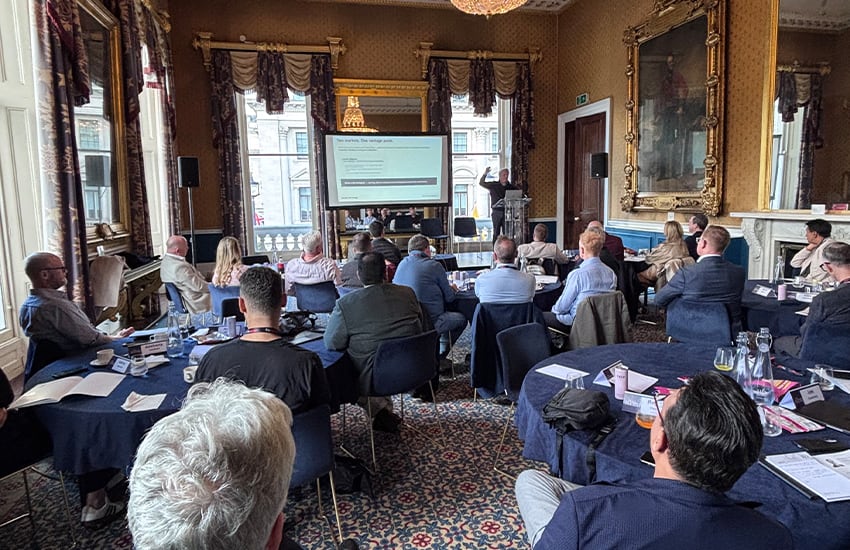
Around 30 C-level leaders from broking firms, aggregators, industry associations, lenders and fintech innovators converged in London for The Adviser’s UK Study Tour between 20-23 October.
Around 30 C-level leaders from broking firms, aggregators, industry associations, lenders and fintech innovators converged in London for The Adviser’s UK Study Tour between 20-23 October.
Convening at the Grade I-listed building 116 Pall Mall (the historic home of the Institute of Directors), the intensive conference compared cross-border lending markets, regulatory shifts, and technological frontiers to help Australian mortgage leaders prepare for what could be coming down the track in Australia.
Attendees were treated to exclusive closed-door briefings and strategic discussions examining regulatory shifts, technology benchmarks, and emerging commercial opportunities across both jurisdictions.
The Adviser UK Study Tour also hosted exclusive private dining networking in heritage venues such as Banqueting House - the only surviving component of the Palace of Whitehall - and NoMad London, a Grade II-listed building that formerly housed The Bow Street Magistrates' Court and Police Station.

Why the UK?
The Adviser Study Tour chose the United Kingdom as its location for the 2026 Study Tour, as it could be viewed as a bellwether for the Australian mortgage market.
While the mortgage market is slightly different from Australia’s (the UK has a predominantly fixed-rate mortgage market and has held its cash rate steady at 3.75 per cent throughout 2026), it is one of the few global jurisdictions commanding a higher broker market share than Australia (around 86 per cent). However, there are far fewer brokers per capita in the UK, with around 23,000 mortgage advisers covering the 70 million people in the UK. This compares to the same number of brokers in Australia to the country’s 27 million population.
UK operators also navigate onerous red tape and an aggressive tax regime, including a 40 per cent inheritance tax threshold and non-retrospective stamp duty that scales up to 12 per cent.
To better understand the challenges and opportunities presented by the UK market, delegates received comprehensive briefings from political analysts, banking executives, aggregator and brokerage chiefs, and association leaders.
Opening the speaker series, Nick Watt, a leading political journalist and commentator, drew upon more than three decades covering general elections, referendums, and global conflicts to unpack Westminster’s political machinery. Speaking ahead of the release of the UK’s Autumn Budget, Watt cut through policy rhetoric to explain how government housing targets, fiscal strategies, and macroeconomic volatility directly drive Bank of England decisions, consumer sentiment, and mortgage policy.
Similarly, Alison Verlander, director of mortgages at lending association UK Finance, delivered a regulatory and sector overview of the market, analysing the operational demands of the Consumer Duty framework, lending affordability stress tests, and how market participants are balancing conduct risk with commercial growth.
Indeed, innovating the home buying process in the UK is a core point of focus for regulators and market participants alike, given that moving house takes an average of 23 weeks from an offer being accepted to completion almost double the amount of time it took 20 years ago. The delays also see around three in 10 property transactions fail to complete.
As such, work is currently underway to digitise the future of the home buying transaction and accelerate and improve the process. Maria Harris, chair of the Open Property Data Association (OPDA), detailed how the OPDA is driving this by establishing open property data standards across lenders, conveyancers, and platforms.
The government-backed Smart Property Data Trust Framework — the first global scheme bringing multiple smart-data sectors together in an interoperable federated model for property transactions — is being designed for secure, consent-based property data sharing modelled on Open Banking and digital identity standards
It intends to standardise secure, consent-based data sharing and digitise home buying and selling by 2030. Early digital property trials reportedly reduced failed transactions by two-fifths.
UK brokerages lift the lid
The delegation also heard from several leading broking groups about how they’re building out their businesses and winning more market share.
Peter Brodnicki, chief executive officer of Mortgage Advice Bureau (MAB), detailed MAB’s path from a 10-broker start-up in 2000 to an LSE-listed network managing more than £30 billion in annual mortgage volume across 2,000 advisers. He provided practical reflections on two decades of growth strategies, proprietary software investments, and diversified distribution channels.
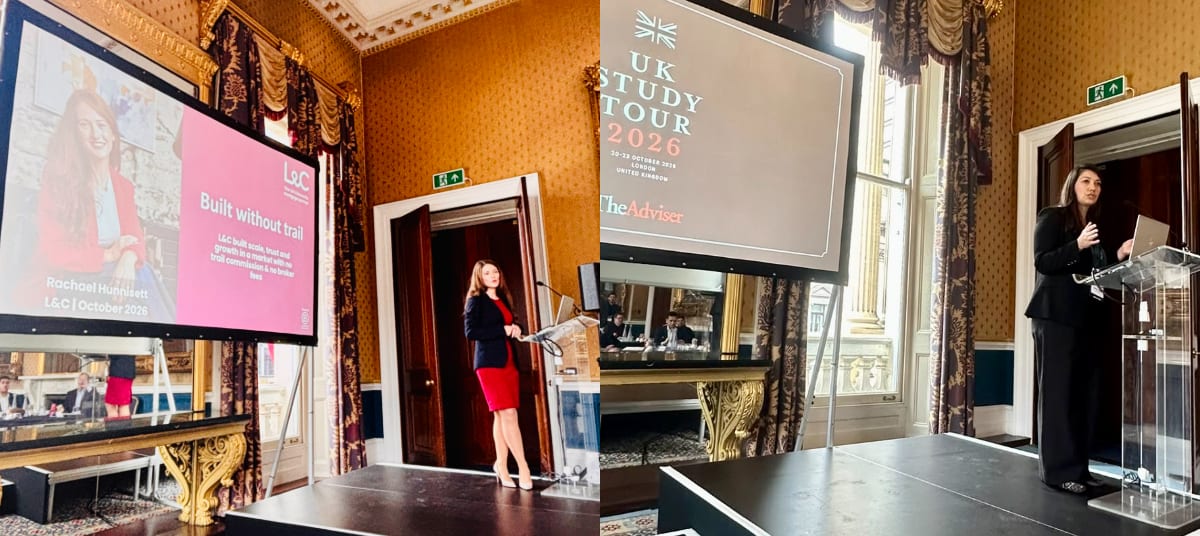
Shifting the lens to operational scale, Rachael Hunnisett from London & Country Mortgages (L&C) unpacked the operating engine behind the UK's largest fee-free mortgage and protection broker.
Operating a telephony-led, high-capacity model in a market without trail commissions, Hunnisett explained how L&C modernises mortgage distribution, challenges traditional retail distribution, and champions consumer-first protection solutions amid shifting economic cycles.
Meanwhile, Mark Harris, chief executive officer of SPF Private Clients, addressed delegates on how he has been building a premium broking business that lasts. Leading a national advisory firm of more than 200 staff, Harris detailed how to scale a high-margin, relationship-led business focused on complex, high-net-worth borrowing while insulating against market commoditisation.
Australian attendees were also treated to an executive fireside chat featuring Kevin Roberts, managing director of mortgage services & savings transformation at Legal & General.
Roberts discussed the architecture of the L&G Mortgage Club, the largest distributor of mortgages in the UK, explaining the club’s revenue mechanics, the practical application of AI versus digital noise, and the long-term evolution of distribution across the UK and Australian markets.
The view from the lenders
Delegates were also provided with exclusive insights from major banks, challenger banks and non-bank lenders at The Adviser’s UK Study Tour.
Speaking on behalf of the UK’s largest lender, Lloyds Banking Group (which accounts for around 20 per cent of the UK mortgage market), James Houston, intermediary market lead at Lloyds Banking Group, addressed delegates on why third-party distribution remains indispensable to the UK's largest retail domestic banking group.
He shared Lloyds' forward-looking commitments to collaborative technology, regulatory compliance, and broker-lender integration to optimise customer outcomes.
Similarly, Caroline Ambrose, managing director of Life Moments Digital Platforms at major bank Barclays UK, took the stage to dissect how the group has been digitising the mortgage experience for brokers.
Drawing on her previous leadership of Barclays’ Open Banking implementation, Ambrose gave delegates a candid look inside a major bank’s digital roadmap, discussing which customer-facing tools have successfully landed with brokers and borrowers and where digital milestone journeys are headed next.
Challenger banks and non-bank lenders also provided confidential updates on how they’ve been building their businesses to prepare for future lending trends.
Tommy Wight, chief operating officer of Vida Bank, delivered a specialist lender's perspective on what intermediaries genuinely want from funding partners. Wight outlined how Vida was engineered specifically around intermediaries, highlighting that lenders win genuine broker loyalty not through marketing, but by consistently delivering processing speed, credit certainty, and transparent underwriting outcomes.
He also unpacked how and why the bank operates with no sales team/BDM team — instead connecting brokers directly with trained underwriters to accelerate enquiries.
Delegates were also challenged to broaden their thinking on how lenders and brokers can better serve the changing demographics of borrowers.
Richard Rowntree, group chief executive officer of Together Money, noted that over £3.8 trillion of UK housing wealth is held by older property owners, but suggested that lenders and advisers were not adequately unlocking equity for retirement wellbeing. He suggested that the underservicing of later-life borrowers represents a missed structural opportunity for financial services.
Building on his experience in both Australia and the UK, Aaron Milburn, managing director of credit access & head of new business UK at Pepper Advantage, delivered a fascinating session on global capital & credit market trends.
Milburn applied his dual-market leadership experience to illustrate how international wholesale capital flows, shifting liquidity profiles, and credit risk repricing across the UK, Europe, and Asia directly impact strategic planning and capital access for Australian mortgage businesses. He suggested that many investors and private funds were actively looking to invest in Australia.
The Pepper Advantage leader also described banks retreating from specialist lending as private credit and asset-backed finance expand and forecast that Australian non-bank lending could reach 25 per cent of the mortgage market by 2028.
Key takeaways from the tour
For many delegates, the study tour revealed that the Australian mortgage market is in a more positive environment than the UK market. However, the headwinds being experienced in the UK provide insight and inspiration to help future-proof Australian businesses.
While Australian brokers have dealt with local market turbulence and evolving compliance demands, delegates observed that UK brokers operate without trailing commissions, relying on upfront procuration fees averaging just 0.40 per cent before network or aggregator splits (however, some mortgage advisers do charge completion fees as well).
In response to these compressed margins, British brokerages have evolved beyond pure mortgage transacting into full-service financial advisory businesses. UK firms routinely generate upwards of 50 per cent of their top-line revenue by cross-selling general insurance, life and protection cover, financial planning, and conveyancing services.
Delegates noted that Australia lags well behind the UK in embedding diversified protection and value-add services directly into the core mortgage journey, suggesting that this could provide a major revenue boost for Australian brokerages.
But British banks and lenders were also praised for maintaining strong alignment with third-party networks and eliminating channel conflict, particularly given the fact that Australia’s big four banks appear to be prioritising direct channel organisations to increase their net interest margin (NIM) on mortgages.
As the Australian mortgage industry continues to explore revenue diversification, digital property transactions, and evolving customer demographics, the insights captured at The Adviser’s UK Study Tour provide an actionable strategic benchmark for local leaders guiding the next decade of third-party distribution.